






TAJIKISTAN — A LAND OF GLACIERS AND GLOBAL INITIATIVES. The Dushanbe Conference Marks a New Era in Glaciers’ Preservation
Read also
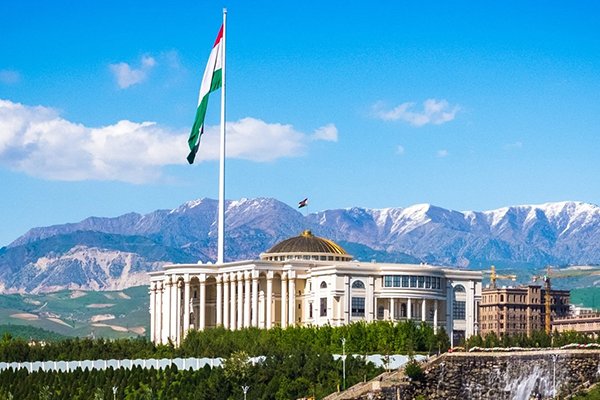
DUSHANBE, 28.05.2025 (NIAT Khovar) – As the global climate crisis accelerates, Tajikistan continues to emerge as a country that not only suffers from its effects but also leads global efforts to address them. With its unique geographic position in Central Asia and home to the region’s largest freshwater reserves, Tajikistan has assumed the role of an international leader in promoting the water and climate agenda.
Since 2003, under the leadership of the President Emomali Rahmon, Tajikistan has launched a series of globally recognized initiatives. These include the International Year of Freshwater (2003), the International Decade for Action «Water for Life» (2005–2015), and the ongoing International Decade for Action «Water for Sustainable Development» (2018–2028). Supported by hundreds of UN member states, these initiatives have laid the foundation for major international water and climate-related conferences hosted in Dushanbe.
In parallel, Tajikistan has also advanced initiatives in countering terrorism and extremism, contributing to the country’s growing global engagement and responsibility.
In a landmark decision, 2025 was declared the International Year of Glaciers’ Preservation by the United Nations General Assembly at Tajikistan’s initiative. This declaration aligns with the country’s broader climate strategy. Glaciers play a crucial role in the region’s ecosystem, supplying around 75% of Central Asia’s freshwater. However, due to climate change, these glaciers are melting at an alarming rate — posing severe threats to water, food, and energy security for millions.
The culmination of this initiative will be the High-Level International Conference on Glaciers’ Preservation, to be held in Dushanbe from May 29 to 31, 2025. The event is expected to bring together over 2,500 participants from dozens of countries, international organizations, research institutes, and development partners. More than 350 journalists, including over 150 foreign media representatives from outlets such as Euronews, Al Jazeera, and leading broadcasters from the Middle East and Asia, will cover the event.
The significance of the conference extends far beyond the region. President Emomali Rahmon has repeatedly emphasized that Tajikistan, a mountainous country with 93% of its territory covered by highlands, is particularly vulnerable to climate change. In his addresses at the United Nations and other global platforms, he has highlighted that countries like Tajikistan, which contribute minimally to global emissions, are disproportionately affected — calling for a fair and equitable distribution of climate responsibilities.
UN Secretary-General António Guterres, in supporting the Tajik initiative, called glacier melt a «troubling indicator» of the climate crisis’ magnitude. He stressed that the most climate-vulnerable countries must receive not only political support but also access to technologies, knowledge, and financial resources.
The Dushanbe conference aims to deliver concrete outcomes, including the development of international scientific platforms for the exchange of climate data and technologies, as well as adaptation strategies for vulnerable nations. Crucially, glaciers are addressed not merely as water sources but as critical components of Earth’s natural capital, essential to global resilience.
Tajikistan is positioning itself as a bridge between science, policy, and global solidarity. Its climate initiatives are not merely declarative — they are backed by action and broad international support. The recognition of glaciers as key ecosystems and climate stabilizers marks not only scientific progress but a strategic pivot in global climate thinking.
In a time of global fragmentation and geopolitical tension, Tajikistan’s approach is especially valuable: it seeks not confrontation, but cooperation. The Dushanbe conference is proof that even a small country can serve as a catalyst for reshaping international climate responsibility.
With over 60% of Central Asia’s water resources forming on its territory, and among the highest per capita freshwater availability globally, Tajikistan’s initiatives carry both strategic legitimacy and moral weight.
In the face of escalating climate threats, it is initiatives like Tajikistan’s that are shaping global consensus. Should even part of the conference’s decisions be implemented by the international community, Dushanbe 2025 may be remembered as a turning point in global climate diplomacy.
Akramkhoja Akbar,
Khovar News Agency
 Dushanbe – A Mirror of the History, Independence and Urban Culture of the Tajik People
 Joint Statement by the Ministries of Foreign Affairs of the Republic of Tajikistan and the Kingdom of Bahrain on the Occasion of the 30th Anniversary of the Establishment of Diplomatic Relations
 The Political School of the Leader of the Nation in the Context of the Activities of the People’s Democratic Party of Tajikistan
 Lonely Planet Includes Tajikistan among the World’s Best Travel Experiences
 Modern Parliamentarism and the Role of the Asian Forum of Parliamentarians on Population and Development: From Experience Sharing to Practice-Oriented Policy Worldwide
 Emomali Rahmon and Xi Jinping Highlight Significance of Launching Direct Passenger Flights between Dushanbe and Beijing
 Tajikistan Provides Key Platform for Science–Policy Dialogue on Glacier Preservation, Says UCA Researcher
 CGTN Journalist Praises Tajikistan’s Leadership on Glaciers’ Issues and Highlights China-Tajikistan Cooperation
 UN Women Official Stresses the Role of Women in Climate Action at Glaciers’ Conference in Dushanbe
 Japanese Researcher Highlights Tajikistan’s Role in Regional Water Security at High-Level Glaciers’ Conference
 “This is Not Just Ice – This is Life”: UN Deputy Chief Calls for Urgent Action at Glaciers Conference in Dushanbe
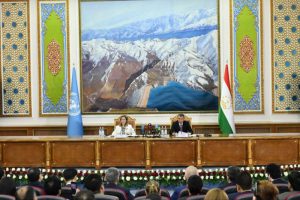 Dushanbe Hosts Landmark International High-Level Conference on Glaciers’ Preservation