








Cross-border disaster risk management training held on Tajik-Afghan border
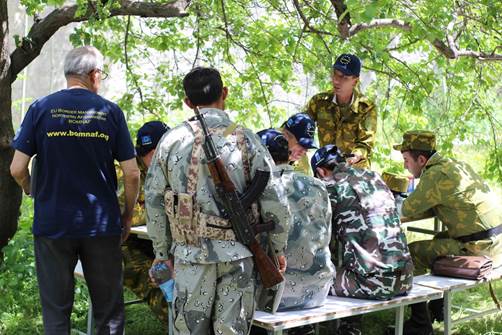
DUSHANBE, 09.06.2017. /NIAT «Khovar»/. UNDP’s EU-BOMNAF and JICA-BMP projects recently implemented a joint disaster risk management training programme in Badakhshan for border police officers and civilians on both the Tajikistan and Afghanistan sides of the international border.
According to the EU Mission in Tajikistan, this activity was conducted at the Nusai-Ruzvai border crossing point (BCP) where the appropriately named Friendship Bridge spans the Panj River, the border between Tajikistan’s Gorno-Badakhshan Autonomous Region (GBAO) and Afghanistan’s Badakhshan Province. Tajik and Afghan border agencies’ staff from the neighbouring BCPs of Khumroghi (Tajikistan) and Djomarji Bolo (Afghanistan) also took part at the training.
Although the BCP is adjacent to Kalai Khumb, administrative capital of Darvoz District, the combination of remote location, tectonic characteristics and natural conditions means the population is particularly vulnerable to natural disasters that include avalanches, earthquakes, floods and landslides.
 Increasingly unpredictable weather patterns leading to unexpected snow melts, rains and fluctuating temperatures have exacerbated the situation, particularly during annual thaws. As nature doesn’t recognize political borders, the close proximity of respective Tajik and Afghan populations will necessitate cross-border cooperation in the face of any large scale disaster.
Training was attended by personnel likely to be mobilized to assist, rescue or evacuate potential victims. Twenty members of the Afghanistan Border Police (ABP), eighteen Tajikistan Border Force (TBF) officers and fifteen local Afghan community leaders were brought together for this three-day course. It is planned that encouraging contact between both sides of the Panj will enhance cooperation, both when natural disasters occur, as well as during the routine course of day to day border management.
Training covered several different aspects of Disaster Risk Management (DRM), focusing primarily around mitigation measures to be used in preparation for any natural disaster responses. Practical applications of this topic included steps taken to formulate plans for response and rescue of affected populations. Participants discussed at length appropriate responses in the aftermath of natural disasters, focusing on events especially common to their area, such as earthquakes and landslides.
Raising awareness of how to react to natural disasters for people in remote villages in these difficult to reach borderlands regions is critical, as emergency response teams can face serious logistical difficulties, delays and obstacles when deployed to such far flung areas. A large quantity of pictographic posters, outlining clear instructions for natural disaster response were given to participants for distribution in their communities as quick reference guides.
 RCU Launches 2026–2027 Archaeology Season Across AlUla and Khaybar to Advance Heritage Research
 Tajikistan Seeks to Strengthen Transport Links Among SCO Member States
 Tajik Ambassador Presents Credentials to Algeria’s Foreign Minister
 Tajikistan and Kuwait Discuss Cooperation on Combating Transnational Crime
 SCO Prime Ministers Gather in Dushanbe for 25th Council Meeting
 Tajikistan, EBRD Discuss Expanding Energy Cooperation and Hydropower Development
 Tajikistan, China Sign Five Cooperation Agreements During Li Qiang’s Visit
 Tajikistan Discusses Economic Cooperation With International Financial Institutions in Bangkok
 Iranian Film Days Open in Dushanbe as Part of Toji Somon Film Awards
 Tajikistan’s Central Bank Chief Discusses Monetary Policy Amid Global Economic Uncertainty in Thailand
 Tajikistan Participates in CIS Defense Ministers’ Meeting in Kyrgyzstan