









President Emomali Rahmon Reviews Progress on Key Construction Facilities at Rogun HPP
Read also
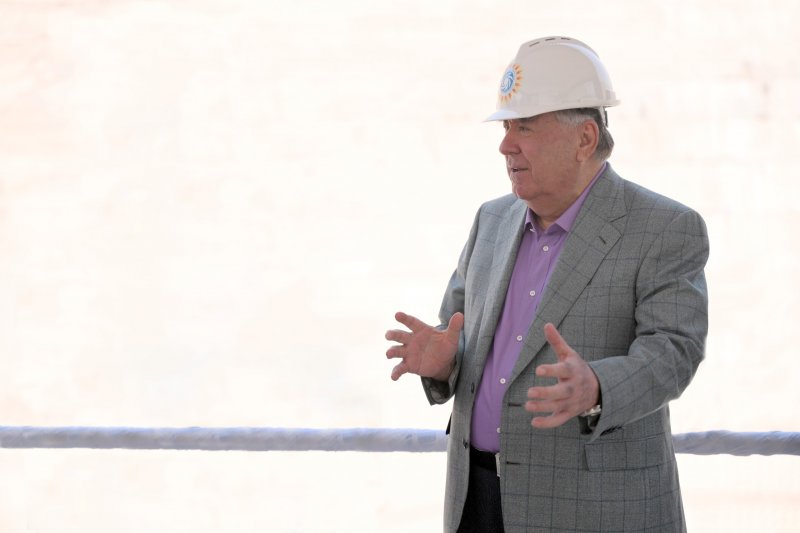
The President of the Republic of Tajikistan, Leader of the Nation, Honorable Emomali Rahmon, continued his working trip to visit the progress of work on the 39th transport tunnel.
The 39th transport tunnel is one of the most important facilities of the Rogun Hydropower Plant, designed to provide transport access from the right bank to the lower part of the power plant complex, both during the construction and operation of the power plant.
According to the set of working plans, the length of the main tunnel route is 2,192 meters. According to the longitudinal profile and general plan, the tunnel starts from the upper part at a level of 1,320 meters, gradually descends and reaches the lower part of the power plant at a level of 1,160 meters.
At the same time, the Leader of the Nation, Emomali Rahmon, was also presented with the project of the upper-level water discharge tunnel, which is 953 meters long.
According to the project, the connection of the 39th road tunnel with the 23rd tunnel and other underground developments of the complex is envisaged.
The main task of the T-39 transport tunnel is to provide a direct and reliable transport route between the right bank and the facilities of the lower part of the Rogun Hydropower Plant, including for the transportation of machinery, equipment, materials, and servicing the facility during the construction and operation of the power plant.
Then, during a working visit to the Rogun Hydropower Plant, the Leader of the Nation, Emomali Rahmon, got acquainted with the progress of construction work on the main water intake at altitudes of 1172 and 1300 meters above sea level.
The task of the main water intake is to supply water to the water supply tunnels from three stages, depending on the water level in the reservoir, and ensure its reliable transport to the units. At the same time, this facility is of great importance for maintaining the strength of the rock layer and preventing the displacement of rock after the reservoir is filled.
The power plant’s water supply system is also being adapted to high engineering requirements. Water from the reservoir directed to the units will enter the water supply tunnels from a height of 1,152 meters for units No. 3 and 4, and from a height of 1,172 meters above sea level for units No. 1, 2, 5, and 6.
One of the important areas of construction work this year is the pouring of structural concrete at the entrance to water supply tunnels No. 3 and 4.
As of August 1, 2026, 10,367 cubic meters of concrete have been poured in this area.
The rapid pace of construction work on the main water intake reflects the high level of engineering and technical work and the use of modern construction capabilities in the construction of this huge facility of the century.
The Leader of the Nation, Emomali Rahmon, while inspecting the construction work at the main water intake facility, instructed the workers to take the necessary measures to complete the planned stages in a timely and high-quality manner.
We recall that during his working visit to the Rogun Hydropower Plant, the President of the Republic of Tajikistan, Emomali Rahmon, was accompanied by the Prime Minister of the Republic of Tajikistan, Kokhir Rasulzoda, other government officials, and heads of relevant ministries and agencies.
The working visit of the President of the country, Emomali Rahmon, continued with the construction of the maintenance and main gates of the permanent water intake at an altitude of 1,300 meters above sea level.
The Head of State had a cordial conversation with specialists and workers of this section in mine number 4, most of whom are employees of the Experimental Mechanical Plant of the city of Norak.
It was noted that currently more than 1,500 specialists of the Experimental Mechanical Plant of the city of Norak are productively working at the Rogun Hydropower Plant.
During the presentation, it was noted that the powerful lifting, loading and unloading machinery and mechanisms can operate for up to 8 hours on a single charge, and this is the first beneficial experience in saving fuel at the facility.
It was reported that reinforcement and structural concrete pouring are currently underway in the upper and underground parts of the shafts in two shifts.
According to the project, an independent water supply road for the power plant’s hydroelectric units, a permanent water intake complex with 6 gate shafts will be built here on a total area of 2,500 square meters.
According to the plan, 65 thousand square meters of concrete and about 5.5 thousand tons of reinforcement will be used to construct the maintenance and main gate shafts of the permanent water intake of the power plant.
To date, 33 percent of the work has been completed on this site.
After the construction of the facility is completed, the shafts will serve to manage and, if necessary, completely close the drainage tunnel under the pressure of each hydroelectric unit, to ensure the possibility of inspecting, repairing the tunnels, and protecting the power plant equipment in emergency situations.
Continuing the working visit to various facilities of the Roghun Power Plant, the construction process in mine No. 17, the construction tunnel of the fourth layer, and the upper discharge tunnels were also in the focus of attention of the President of the Republic of Tajikistan, Leader of the Nation, Honorable Emomali Rahmon.
The Leader of the Nation’s acquaintance with the progress of production and construction work at this facility began from the observation deck of mine No. 17. According to information, seven enterprises are currently operating at mine No. 17, with a processing and production capacity of 10 to 12 thousand cubic meters per day, including alumina, sand, and crushed stone.
The round-the-clock operation of processing enterprises at mine No. 17 lays an important foundation for ensuring the necessary reserves of materials and increasing the volume of products used in the construction of the power plant dam.
According to information, the construction tunnel of the fourth layer has the capacity to pass up to 3,500 cubic meters of water per second. Therefore, ensuring the safe and controlled movement of such a large volume of water is one of the important technical requirements of the facility.
High-quality implementation of construction work at this important facility is of key importance for ensuring the safety, stability, and efficient operation of the power plant and is one of the important directions in the process of building this large energy facility in the country.
The President of the Republic of Tajikistan inspected the progress of work on the breakwater basin of the right-bank spillway tunnels of the Rogun Hydropower Plant.
The breakwater basin is one of the structures of the right-bank spillway complex of the Rogun Hydropower Plant. It is designed to receive high-speed water flows from the ST-4A and ST-4B construction tunnels, the upper-level spillway tunnel TVVU-1 and the TVP-1 and TVP-2 spillway tunnels, reduce the energy of the flow and create safe conditions for water entering the Vakhsh River channel.
The geometry of the basin was determined taking into account the trajectory of water fountains, the results of physical model tests, mathematical calculations, and the possibility of stream washout.
According to the project, the preparation of the breakwater basin is planned in two stages, and its main part will be lowered to a level of 945.0 meters. The reinforcement of the right bank is determined taking into account the maximum design flow of 1,750 cubic meters per second. To ensure safety, the base of the right bank slope is located no less than 20 meters, and the left bank is located approximately 20-30 meters from the point of impact of the design water fountain.
The Leader of the Nation, Emomali Rahmon, was informed that, according to hydraulic calculations, the breakwater itself acts as an energy-absorbing structure and a controlled washout zone, designed to reduce the impact of powerful water flows and ensure the stability of the banks.
The Head of State, Emomali Rahmon, emphasized that in the course of further work, priority should be given to the quality of work, stability of slopes, reinforcement of banks, and ensuring the safety of the facilities in the lower part of the power plant.
Continuing his visit, the Leader of the Nation, Emomali Rahmon, inspected the progress of construction work and hydromechanical equipment of the main and repair gates of ST-4 of the Rogun Hydropower Plant.
The chamber and control building of the emergency-repair and main gates of ST-4 (Construction Tunnel of the 4th layer) is one of the most important underground hydraulic structures on the right bank of the Rogun Hydropower Plant, designed to control and regulate water flow, close the water-carrying sections of the tunnel in emergency situations, as well as create conditions for inspection, repair and maintenance of hydromechanical equipment.
The construction tunnel ST-4 is designed to divert flood waters from the Vakhsh River during the construction of the dam and the main structures of the power plant, and its water intake threshold is located at a level of 1090.0 meters. The maximum water throughput capacity of the tunnel is 3,500 cubic meters per second, and its hydromechanical equipment is designed to operate under water pressure conditions of up to about 150 meters.
Four working radial gates are the main regulating equipment of ST-4. They are used to fully or partially open the gates, regulate the flow of water downstream, maintain a certain level of water upstream, and close the gate if necessary.
The Leader of the Nation, Emomali Rahmon, was informed that a single power supply system is provided for four sets of radial gates.
In the event of a power outage from the main source, the system automatically switches to the backup source. At the same time, information about the operating power source is transmitted to the power plant dispatch system.
In general, the ST-4 gate control chamber and building is a complex underground hydraulic and automated complex.
The Head of State, Emomali Rahmon, emphasized that the implementation of large-scale construction work in difficult underground conditions is the result of the use of advanced experience, modern technology, and the efforts of domestic specialists, and it is necessary to make greater efforts to further qualitatively and timely implement the foundation works.
We recall that during his working visit to the Rogun Hydropower Plant, the President of the Republic of Tajikistan, Honorable Emomali Rahmon, was accompanied by the Prime Minister of the Republic of Tajikistan, Kokhir Rasulzoda, other government officials, and heads of relevant ministries and agencies.
 President Emomali Rahmon Meets with Heads of SCO Member State Delegations in Dushanbe
 President Emomali Rahmon Meets First Vice President of Iran Mohammad Reza Aref
 President Emomali Rahmon Inaugurates 20 Development Facilities in Rudaki District
 President Emomali Rahmon Inaugurates New Education Department Building in Rudaki District
 President Emomali Rahmon Inaugurates New Palace of Culture in Rudaki District
 President Emomali Rahmon Meets Chinese Premier Li Qiang in Dushanbe
 President of Tajikistan Emomali Rahmon Calls for Stronger Global Cooperation on Biodiversity Conservation
 President of Tajikistan Emomali Rahmon Arrives in Armenia for Biodiversity Conference
 President Emomali Rahmon Meets with President Ilham Aliyev in Baku
 President Emomali Rahmon Arrives in Baku to Participate in the Seventh CICA Summit
 President Emomali Rahmon Departs for Azerbaijan to Attend the Seventh CICA Summit