







President of COP29: “Tajikistan’s Initiative Is a Powerful Call for Global Action to Preserve Glaciers”
Read also
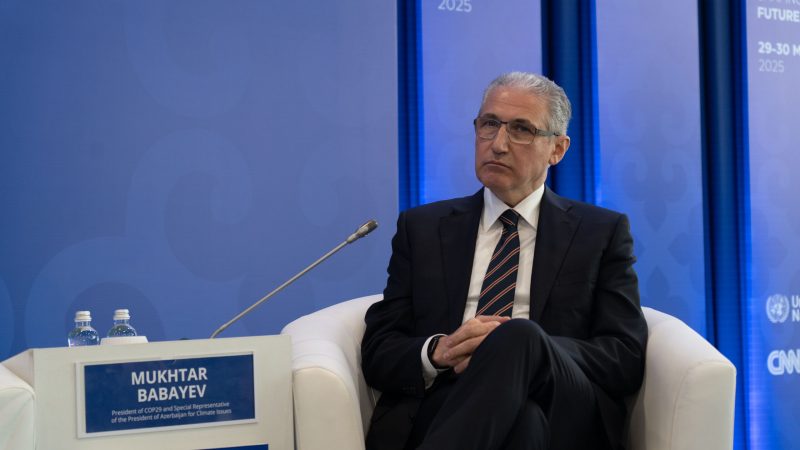
DUSHANBE, 05.08.2025 (NIAT Khovar) – Tajikistan’s initiative to declare 2025 the International Year of Glaciers’ Preservation is becoming increasingly relevant in the face of accelerated glacier melt and growing climate threats. With billions of people around the world dependent on glacier-fed water, this call for global action marks an important step in mobilizing the international community and strengthening cooperation to safeguard water resources and ensure a sustainable future. The President of the 29th Conference of the Parties to the UN Framework Convention on Climate Change (COP29), Mr. Mukhtar Babayev, shared his views with a correspondent of NIAT “Khovar”.
– In your opinion, what are the most pressing climate risks and challenges today?
– Mountain regions are especially vulnerable to climate change — they are warming faster than other parts of the planet.
This has a devastating impact on water systems: glaciers are melting, and weather patterns are shifting. Between 2000 and 2023, the world lost over 6,500 gigatons of glacier mass. As a result, water infrastructure is under pressure, agriculture is disrupted, and people’s livelihoods and health are at risk.
These are challenges our countries know well. Half of Central Asia’s population lives in areas with high water stress. In Azerbaijan and the Caucasus, we have already lost nearly 20 percent of glaciers in just seven years.
It is essential that the global community directs its efforts in the right direction and ensures that mountain regions receive due attention in the climate agenda.
– How would you assess the international climate initiatives of the President of the Republic of Tajikistan, Emomali Rahmon — especially those aimed at glacier preservation and sustainable water resource management?
– Glacier preservation and water management are global challenges that can only be addressed through close international cooperation. We are grateful to Tajikistan for its active efforts to unite the global community around these shared concerns. In Azerbaijan, we understand the positive influence that political leadership can have on global efforts. The COP29 Presidency expresses its gratitude to President Ilham Aliyev of Azerbaijan for his leadership and support in prioritizing climate change and water management on the international agenda.
Tajikistan demonstrated strong leadership by organizing the International Conference on Glacier Preservation — a significant forum in which the COP29 Presidency was honored to participate. The event marked a milestone in raising the issue of glacier preservation to the forefront of the international climate agenda and acted as a catalyst for intensified global cooperation in this strategically important area.
Tajikistan has consistently demonstrated international leadership on water issues by hosting regular conferences as part of the Dushanbe Water Process — a key initiative of the International Decade for Action “Water for Sustainable Development.” We also look forward to attending the UN Water Conference to be held in Tajikistan in 2028.
– How relevant and timely do you find Tajikistan’s initiative to declare 2025 the International Year of Glacier Preservation?
– This initiative is both timely and extremely important. Glaciers are melting at an alarming rate. The consequences will be truly global — not only for mountain communities, but also for nearly two billion people who depend on glacier-fed water, as well as coastal communities threatened by rising sea levels.
Tajikistan’s initiative is a powerful call to action that will help focus and intensify global efforts on this vital issue. In Azerbaijan, we clearly understand the value of such declarations in uniting the international community, and we are working to rally global support for glacier preservation and sustainable water management.
– What are your impressions of the High-Level International Conference on Glacier Preservation in Dushanbe?
– The Dushanbe Conference made a valuable contribution to global climate action by highlighting the urgent threat that climate change poses to glaciers. It reaffirmed an essential truth: glaciers and water systems know no borders, and addressing their decline requires international cooperation.
The Dushanbe Glaciers Declaration adopted at the conference sets out key commitments to address both the causes and consequences of glacier melt, and will serve as a catalyst for action in this direction.
The conference was also a meaningful opportunity for the COP29 team to remind international leaders of the promises made in Baku. In particular, it served as a platform to urge donor countries to fulfill their climate finance commitments.
– In your opinion, how important is regional solidarity in addressing the challenges of climate change?
– Regional solidarity is key in confronting the climate crisis. Climate change knows no borders, and our response must be just as global and coordinated.
When countries join forces, they can scale solutions, share resources, and build resilience no single nation could achieve alone. Climate leadership today requires a shared sense of responsibility and a commitment to progress together.
Central Asia, with its vast renewable energy potential — over 5,000 gigawatts of solar power alone — has a unique opportunity to lead the green energy transition. But unlocking this potential requires coordinated work — from policy alignment to infrastructure development and innovation.
Azerbaijan is committed to working closely with our neighbors in Central Asia to drive progress. For example, we are part of the Caspian Sea partnership for environmental protection and have signed agreements with Kazakhstan and Uzbekistan to create new green energy zones and corridors.
We remain committed to hosting dialogues that unite our region and the world around common goals. That is why we will host the World Urban Forum in Baku in 2026 to promote international cooperation in sustainable urban development. We warmly welcome the government and business community of Tajikistan to join us.
– What forms of cooperation between Tajikistan and Azerbaijan in climate and water do you see as the most promising?
– Tajikistan and Azerbaijan face similar climate-related challenges and opportunities. This creates a valuable platform for sharing experiences and mutual learning.
Both countries are affected by glacier melt and water stress, making water issues a shared priority. We can build on our history of supporting each other’s international initiatives in climate and water, as well as our cooperation in agriculture.
There is also great potential to expand existing collaboration in energy, as both our countries embrace the energy transition.
Overall, we have a strong opportunity to protect our populations from the impacts of climate change while achieving both sustainable development and decarbonization.
 Meeting of the Government of the Republic of Tajikistan
 Dushanbe to Host International Forum on Sustainable Development, Green and Digital Transformation in April 2026
 Tajik Delegation Competes at International Delphic Games in Kyrgyzstan
 Tajik, Uzbek Writers Celebrate Navruz at “Literary Friendship – Eternal Friendship” Event
 Dushanbe to Host International Judo Grand Slam 2026
 FAO to Hold 35th Regional Conference in Dushanbe on Food Security, Climate Issues
 Tajik Cinema Days Open in Uzbekistan, Showcasing National Films
 Youth Navruz Festival Opens in Dushanbe with Global Participants, Cultural and Sports Events
 Emomali Rahmon Urges Pride in National Heritage, Unity in Navruz Message
 Tajikistan, India Discuss Energy Cooperation at New Delhi Summit
 Tajikistan Showcases Culture, Literature at Minsk International Book Fair
 Dushanbe Conference Panels to Assess Decade for Water Action Progress