





SCO Prime Ministers Gather in Dushanbe for 25th Council Meeting
Read also
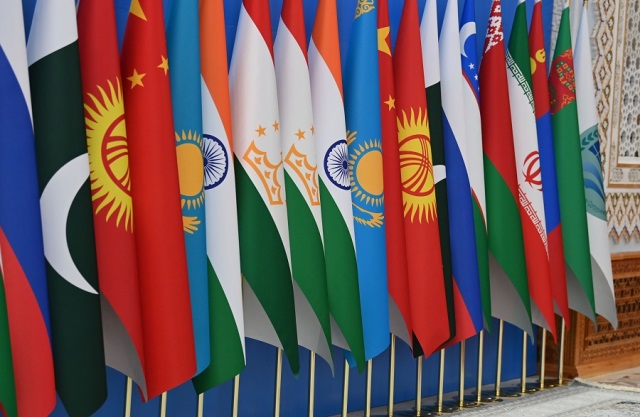
Dushanbe is hosting the 25th meeting of the Council of Heads of Government of the Shanghai Cooperation Organization, or SCO, with trade, economic cooperation and investment expected to feature prominently on the agenda, Khovar reports.
The meeting is one of the key events of Tajikistan’s 2026 chairmanship of the organization. An organizing committee was established to coordinate preparations and ensure the event runs smoothly.
The SCO traces its origins to the Shanghai Five, formed by Tajikistan, Kazakhstan, China, Kyrgyzstan and Russia through agreements signed in 1996 and 1997 on confidence-building measures and the reduction of armed forces in border areas.
At a summit in Dushanbe in 2000, the five countries proposed transforming the group into a broader regional cooperation framework. The initiative was reflected in the Dushanbe Declaration adopted July 4, 2000.
On June 15, 2001, the group expanded to include Uzbekistan, and the leaders signed a declaration establishing the SCO in Shanghai.
The organization has since developed into a regional platform for political, economic, security and cultural cooperation. Its activities are guided by the “Shanghai Spirit,” which emphasizes mutual trust, mutual benefit, equality, consultation, respect for cultural diversity and the pursuit of common development.
The SCO’s member states account for a substantial share of the world’s population and territory. Its priorities include strengthening good-neighborly relations, expanding cooperation in trade, the economy, science, technology, culture, education, energy, transportation and tourism, and promoting regional peace, stability and security.
The organization expanded further in recent years. India and Pakistan became full members in 2017, followed by Iran in 2023 and Belarus in 2024.
The SCO currently has 10 member states: Belarus, India, Iran, Kazakhstan, China, Kyrgyzstan, Pakistan, Russia, Tajikistan and Uzbekistan. Afghanistan and Mongolia hold observer status, while 14 countries are dialogue partners: Azerbaijan, Armenia, Bahrain, Egypt, Cambodia, Qatar, Kuwait, the Maldives, Myanmar, Nepal, the United Arab Emirates, Saudi Arabia, Turkey and Sri Lanka.
The organization’s permanent bodies are the SCO Secretariat, based in Beijing, and the Executive Committee of the SCO Regional Anti-Terrorist Structure, based in Tashkent. Both began operating in January 2004. Chinese and Russian are the organization’s official languages.
Combating terrorism, separatism, extremism and related threats is a central part of the SCO’s work. The Regional Anti-Terrorist Structure coordinates cooperation among member states, while joint counterterrorism and military exercises support their security efforts.
Tajikistan is a founding member and an active participant in the organization. It has chaired the Council of Heads of State in 2008, 2014 and 2021, and the Council of Heads of Government in 2006, 2010 and 2018.
The 2021 SCO summit in Dushanbe was a milestone in the organization’s development and marked the conclusion of Tajikistan’s 2020-21 chairmanship. The summit resulted in the signing of 30 documents, the largest package adopted at an SCO summit at that time.
Under the theme “20 Years of the SCO: Cooperation for Stability and Prosperity,” Tajikistan organized about 100 joint events during its chairmanship. The anniversary summit adopted the Dushanbe Declaration on the 20th Anniversary of the SCO, outlining the organization’s achievements and members’ shared positions on major regional and international issues.
Tajikistan also promoted new cooperation platforms, including meetings of SCO member states’ ministers responsible for industry and energy. To mark the organization’s 20th anniversary, the SCO Center for Friendship and Cooperation in Tajikistan was opened at the Academy of Public Administration under the President of Tajikistan. An SCO anthem developed at Tajikistan’s initiative was performed for the first time during the anniversary summit.
Economic cooperation has remained another priority. On July 4, 2023, the SCO adopted its Economic Development Strategy through 2030 at a summit in New Delhi, following an initiative by Tajik President Emomali Rahmon. An action plan for implementing the strategy was approved at the 2024 summit in Astana. The strategy covers multiple economic sectors, with particular emphasis on green development, sustainable growth and improving living standards across the region.
Tajikistan has also promoted cooperation on antitrust regulation and the prevention of unfair competition. The first meeting of heads of antimonopoly agencies from SCO member states was held in Dushanbe in May 2024.
At the July 4, 2024, summit in Astana, the SCO Council of Heads of State approved the establishment of an SCO Anti-Drug Center in Dushanbe. The center is intended to strengthen coordination among member states’ law enforcement agencies and improve joint efforts to combat illicit drug trafficking.
Tajikistan continues to prioritize the SCO as a framework for strengthening political dialogue, regional security and mutually beneficial economic cooperation. Its stated approach emphasizes continuity, equality, mutual respect and consideration of the interests of all member states and dialogue partners.
 Tajikistan and Kuwait Discuss Cooperation on Combating Transnational Crime
 Tajikistan, EBRD Discuss Expanding Energy Cooperation and Hydropower Development
 Tajikistan, China Sign Five Cooperation Agreements During Li Qiang’s Visit
 Tajikistan Discusses Economic Cooperation With International Financial Institutions in Bangkok
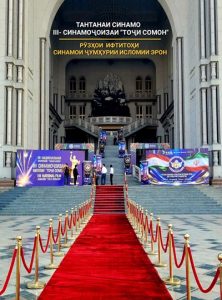 Iranian Film Days Open in Dushanbe as Part of Toji Somon Film Awards
 Tajikistan’s Central Bank Chief Discusses Monetary Policy Amid Global Economic Uncertainty in Thailand
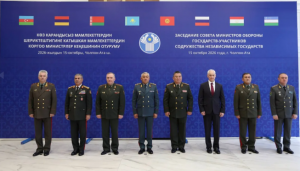 Tajikistan Participates in CIS Defense Ministers’ Meeting in Kyrgyzstan
 Tajikistan, Sri Lanka Discuss Bilateral Cooperation on Sidelines of CICA Summit
 Tajikistan Reviews Progress on State Greening Program Through 2040
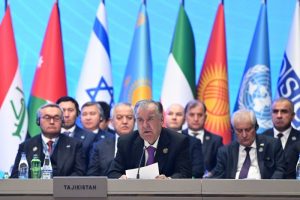 Tajikistan to Host U.N.-Backed Peace Conference in Dushanbe in May 2027
 G10 Insight Forum 2026 Opens in Dushanbe to Explore Business and Investment Opportunities