







Tajikistan Initiative Leads to First International Glacier Day
Read also
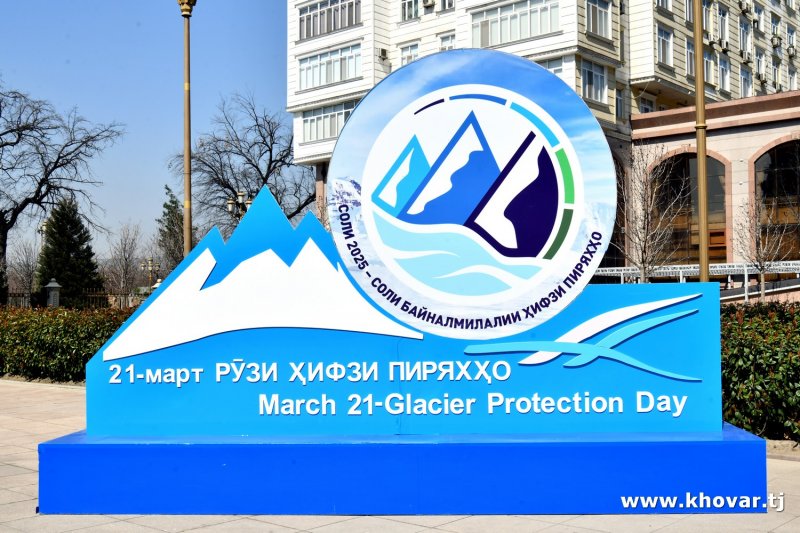
DUSHANBE, 21.03.2026 (NIAT Khovar) – March 21 marks International Glacier Day, established in 2025 at the initiative of Tajikistan through a United Nations General Assembly resolution.
To commemorate the occasion, the first high-level international conference on glacier conservation was held in Dushanbe on May 30-31, 2025, bringing together representatives from 80 U.N. member states and international organizations. President Emomali Rahmon of Tajikistan described the conference as an important step in implementing the U.N. resolution declaring 2025 the International Year of Glaciers and highlighted the rapid melting of glaciers as a global crisis.
Experts say 2023 saw the largest annual glacier loss on record, with about 600 gigatons of freshwater lost, contributing to rising global sea levels. Climate change has already led to the disappearance of roughly one-third of the world’s mountain glaciers. Rahmon said addressing the issue requires coordinated international efforts. Tajikistan, home to the largest glaciers in Central Asia, is also directly affected.
To help preserve glaciers, Rahmon called for urgent measures, including raising public awareness of their importance, strengthening international cooperation, expanding monitoring and scientific research, and addressing the social and economic consequences of glacier loss, such as impacts on water access, food security, energy production, and cultural and natural heritage.
Experts note that glaciers are critical to the Earth’s ecosystem, playing a key role in the water cycle and climate regulation while serving as a major source of freshwater for many regions. However, rising temperatures continue to accelerate glacier loss worldwide, with little natural recovery.
In Tajikistan, about 1,300 of the country’s 14,000 glaciers — which provide up to 60% of the region’s freshwater — have already disappeared.
The designation of 2025 as the International Year of Glacier Conservation, the establishment of March 21 as International Glacier Day, and the creation of an international fund are seen as concrete steps to address growing environmental challenges. These initiatives aim to raise global awareness and strengthen scientific, financial and technical cooperation.
For more than two decades, Tajikistan’s global initiatives on water resources, climate change and glacier preservation have received U.N. support and played a significant role internationally.
Emomali Rahmon said glacier preservation is not only a concern for countries with glaciers but a global issue requiring urgent attention. While Tajikistan has institutions dedicated to glacier research, he noted that technical capacity remains limited and called for greater international cooperation, innovation and funding.
Noting that more than 60% of the region’s glaciers are located in Tajikistan, Rahmon proposed organizing a comprehensive international expedition to study the country’s glaciers and establishing a regional glacier research laboratory. He also invited partners to support the “Decade of Action for Glacier Science 2025-2034.”
To date, 15 U.N. General Assembly resolutions on water and climate issues have been adopted at Tajikistan’s initiative.
The fourth high-level international conference on the implementation of the International Decade for Action, “Water for Sustainable Development, 2018-2028,” is scheduled to be held in Dushanbe in May. The conference will focus on implementing commitments, strengthening cooperation, advancing the global water agenda, and reviewing progress made under the decade.
 Tajikistan, Uzbekistan Expand Artel Avesto Electronics Project to Boost Output to 300,000 Units
 Tajikistan, Saudi Arabia Expand Cooperation in Vocational Education
 Tajik Transport Digital Center Secures IT Park Resident Status
 CIS Officials Meet in Minsk to Prepare Upcoming Summits
 Tajikistan, China Sign Deal to Expand Health Cooperation
 Emomali Rahmon Calls for Strengthening Patriotism Among Youth at Navruz Celebration
 Tajikistan, Uzbekistan Discuss Expanding Customs Cooperation
 Tajikistan Eyes Renewable Energy Boost With 500-MW Solar Initiative
 Experts to Discuss Climate Resilience at Dushanbe Water Conference
 Meeting of the Government of the Republic of Tajikistan
 Dushanbe to Host International Forum on Sustainable Development, Green and Digital Transformation in April 2026